![podaris_logo_png.png]](https://support.podaris.com/hs-fs/hubfs/podaris_logo_png.png?height=50&name=podaris_logo_png.png)
Accessing privacy settings
You can find your project's privacy settings on the Project Settings page.
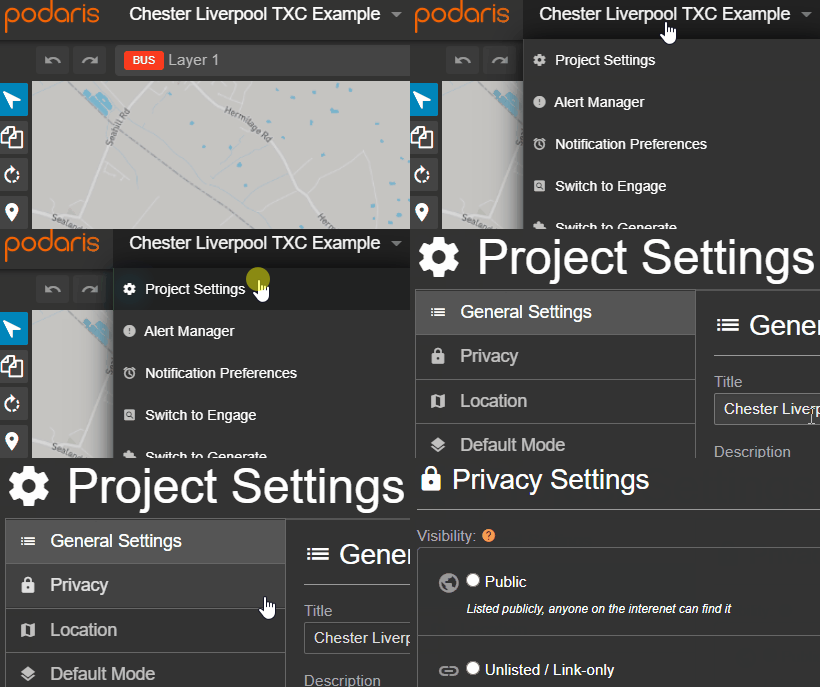
Project visibility settings
Project visibility controls who in your organisation can discover and join a project.

-
Members: The project is listed for everyone in your organisation. Organisation members can find it and self-join — see [Member self-join access](#selfjoin) below to control what role they join with.
-
Private: Only invited collaborators can view the project. A project administrator must explicitly add each collaborator with a role.
Projects inside a workspace don't show the visibility radios — workspace projects are always scoped to workspace members.
Member self-join access
When a project's visibility is set to Members, organisation members can self-join it. The Member self-join access setting controls the role they receive when they do.
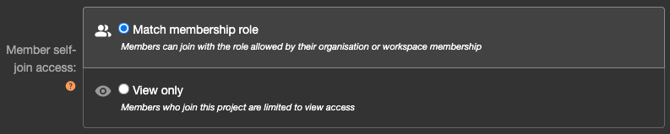
-
Match membership role: Members join with the role allowed by their organisation (or workspace) membership. An organisation `edit` or `admin` member, for example, would join with edit or admin permissions. This is the default and preserves the previous behaviour.
-
View only: Members who self-join are limited to view access, regardless of their organisation role. Use this when you want a project to be widely discoverable and cloneable but kept read-only — for example, a master GTFS file, a reference dataset, or a project template that should not drift.
This setting only constrains *self-join*. Project owners and administrators can still add collaborators directly at any role, and can approve access requests at any role.
Tip: To publish a read-only, cloneable project to your whole organisation, combine Visibility: Members + Member self-join access: View only + Public access: Disabled + Who can clone: Everyone.
License Type
The license setting lets you mark the project as Creative Commons, All Rights Reserved, or something else. Choose the option that matches how you want collaborators and viewers to be able to reuse the project's content.

Cloning settings
Cloning controls who can duplicate the project into their own workspace.
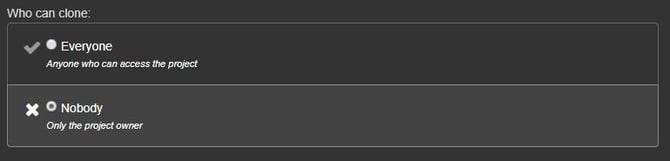
-
Everyone: Anyone who can access and view the project can clone it.
-
Nobody: Only the owner can clone the project.
Cloning always requires the user to be able to view the project first — sharing a clone link doesn't bypass the project's visibility setting.
Project access settings
Public access controls how people *outside* your organisation can interact with the project through a shared link in Podaris:Engage.
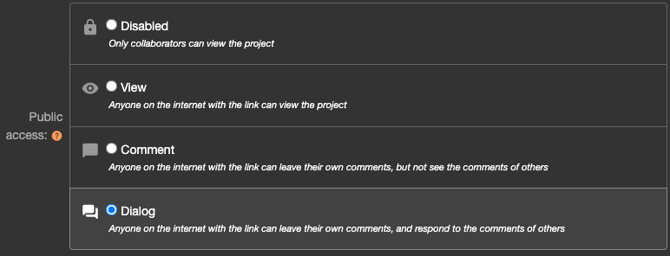
- Disabled: Only collaborators can view the project. No public link access.
-
View: Anyone on the internet with the link can view the project, but cannot comment.
-
Comment: Anyone with the link can leave their own [comments on the views](https://support.podaris.com/comment-tool), but cannot see comments left by other public users. Useful when you want direct feedback without starting a wider discussion.
-
Dialog: Anyone with the link can comment *and* see and respond to other people's comments. Useful when wider discussion is beneficial.
Public links remain valid as long as the project's settings allow public access. If you later switch Public access back to Disabled or change Visibility to Private, any link you previously shared will stop working.